In this article
- 01What is a product options API?
- 02What data does the Aris Product Options API provide?
- 03Public API vs. Webview API: What's the difference?
- 04When does a Shopify store need a product options API?
- 05Which Aris plan includes API access?
- 06What should developers check before integrating?
- 07Frequently asked questions
- 08Connect product options to your store's systems
What is a product options API?
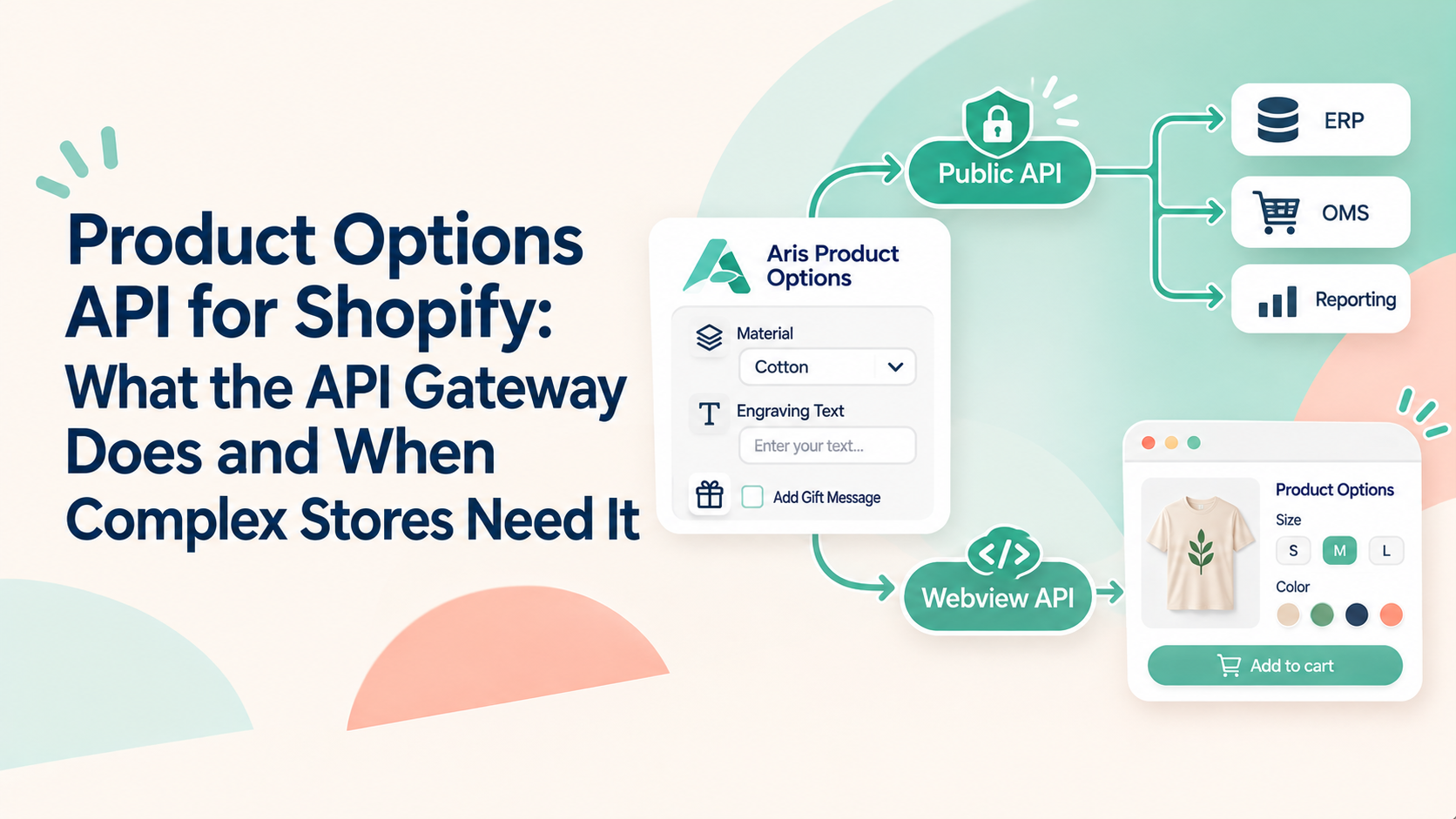
Aris Product Options offers two integration capabilities:
Public API: Retrieves option sets, app settings, and localization data for server-side integrations.
Webview API: Displays Aris options in custom storefronts, themes, widgets, and other frontend experiences.
What data does the Aris Product Options API provide?
https://public-api.avisplus.io/api/public/v1Endpoint | Purpose |
|---|---|
| Retrieve a list of option sets |
| Retrieve a specific option set |
| Retrieve app and storefront settings |
| Retrieve translated interface strings |
Public API vs. Webview API: What's the difference?
Public API | Webview API | |
|---|---|---|
Main purpose | Retrieve option configuration | Display Aris options in a custom frontend |
Environment | Backend / server-side | Storefront / browser |
Token | API Token | Webview Token |
Minimum plan | Advanced | Premium |
Example use | ERP, reporting, internal tools | Custom product page, headless storefront, embedded widget |
Rate limit | 60 requests/minute | 600 requests/minute |
When does a Shopify store need a product options API?
API access becomes more useful when product configuration is part of a larger technical workflow.
ERP and order-management workflows
A backend can retrieve option configurations to keep product rules aligned across systems. For example, a furniture retailer may need its internal tools to reference the same material, finish, and dimension options shown on Shopify.Custom production workflows
Personalized products may require configuration details to support production. However, developers must separately identify how to retrieve each customer's submitted choices: the documented Public API does not list an order retrieval endpoint.Custom configurators and headless storefronts
Stores building a tailored product experience can use Webview to display Aris options in a custom frontend instead of relying only on the standard app block.Internal tools and reporting
The Public API can supply option-set configuration for internal dashboards or reporting workflows. Building those tools and combining the data with other business information still requires development.
Which Aris plan includes API access?
Plan | Public API | Webview | Webhooks | Included API calls |
|---|---|---|---|---|
Free | No | No | No | — |
Pro | No | No | No | — |
Advanced | Yes | No | No | 5,000 / billing cycle |
Premium | Yes | Yes | Yes | 25,000 / billing cycle |
Before choosing a plan, keep these limits in mind:
Billing cycle: Usage resets every 30 days according to the app billing cycle.
Shared quota: Premium API Token and Webview Token requests share the same 25,000-call allowance.
Rate limits: Public API supports 60 requests/minute per shop; Webview supports 600.
Overage: The documented policy lists additional 5,000-call blocks at $5 for Advanced and 25,000-call blocks at $10 for Premium, subject to the approved spending cap.
What should developers check before integrating?
Before building, clarify four things:
Data needed: Does the system need option configurations, translations, customer selections, or order records?
Integration direction: Does it only need to read data, or must it also create or update information?
Environment: Is this a server-side integration (Public API) or a browser-facing storefront experience (Webview)?
Expected usage: Estimate requests per product page, sync job, or update event before selecting a plan.
Frequently asked questions
Does Aris have a product options API for Shopify?
Which plan includes API access?
Can the API retrieve customer orders?
Is Webview the same as Public API?
Connect product options to your store's systems
Before development starts, identify exactly which data the external system needs, especially whether it needs option configuration or individual customer order data.