
In this article
- 01Quick comparison: bundle vs volume discount vs BOGO
- 02What is a bundle discount?
- 03What is a volume discount?
- 04What is a BOGO promotion?
- 05Choose based on the business objective
- 06Calculate the margin before publishing
- 07A simple selection framework
- 08What to measure after launch
- 09Final recommendation
- 10Frequently asked questions
The decision between a bundle vs volume discount is not just about which promotion looks more generous. Each offer changes what customers buy, how inventory moves and how much margin remains. BOGO adds a third option that can be powerful when the “free” or discounted item has strong perceived value.
This guide compares all three promotion types so you can match the mechanics to the customer behavior you want.
Quick comparison: bundle vs volume discount vs BOGO
What is a bundle discount?
A bundle discount rewards the purchase of a defined group of products. For example, a skincare brand might combine cleanser, serum and moisturizer for a lower total than buying each separately.
Bundles work best when the products solve a broader problem together. The shopper is not merely receiving a discount; they are getting a curated solution and avoiding additional decisions.
Use a bundle when:
- Products are naturally complementary.
- Customers need guidance on what works together.
- You want to introduce a lower-discovery product.
- The combined offer supports a specific routine or outcome.
- You can fulfill and return components accurately.
What is a volume discount?
A volume discount changes the unit economics as quantity increases. A common structure is “Buy 2, save 5%; buy 4, save 10%; buy 6, save 15%.”
This promotion is strongest when customers already have a reason to consume, share or stock several units. It is less persuasive for durable products that are purchased once every few years.
Use a volume discount when:
- The product is replenishable or frequently used.
- Customers buy for teams, events or households.
- Higher quantities improve picking or shipping efficiency.
- Your margin can support the highest tier.
- You want a lightweight wholesale-style offer.
What is a BOGO promotion?
BOGO means “buy one, get one,” but the second item does not always have to be free. It may be discounted, selected from an eligible group or added as a gift after a threshold.
BOGO works because the unlocked item is tangible. Customers can perceive “get a travel-size serum” differently from a mathematically equivalent percentage discount.
Use BOGO when:
- You want customers to sample a related product.
- The reward has high perceived value and manageable cost.
- You need to move a specific inventory position.
- The qualifying and reward products are easy to explain.
- The campaign has clear stock and end-date controls.
Choose based on the business objective
Increase items per order
All three can work. Choose bundles for complementary variety, volume discounts for multiple units and BOGO when an unlocked reward creates the strongest motivation.
Introduce a new product
Include a trial size in a bundle or offer it as the BOGO reward. Avoid a deep standalone discount that establishes a low reference price before customers understand the product.
Move overstock
Use BOGO or a bundle if the overstock complements a strong seller. Make sure the promotion does not teach repeat customers to wait for clearance.
Support wholesale or bulk buyers
Volume discounts are usually the most legible. Define tiers from contribution margin and operational savings, not from round numbers alone.
Improve product discovery
Curated bundles can introduce adjacent categories while preserving a coherent customer story.
Calculate the margin before publishing
Start with contribution margin, not revenue. For each offer, include:
- Product cost
- Pick and pack cost
- Packaging
- Payment fees
- Shipping subsidy
- Expected returns, damage or support cost
- Discount or reward cost
A larger order can still be worse for the business if the promotion increases shipping, handling and returns faster than gross profit.
A simple selection framework
- 1.Define the behavior you want: more categories, more units or a qualifying purchase.
- 2.Identify the products that naturally support that behavior.
- 3.Calculate the worst-case margin at maximum discount.
- 4.Choose one clear offer and one primary message.
- 5.Test eligibility, discount stacking and sold-out states.
- 6.Measure incremental profit, not only order value.
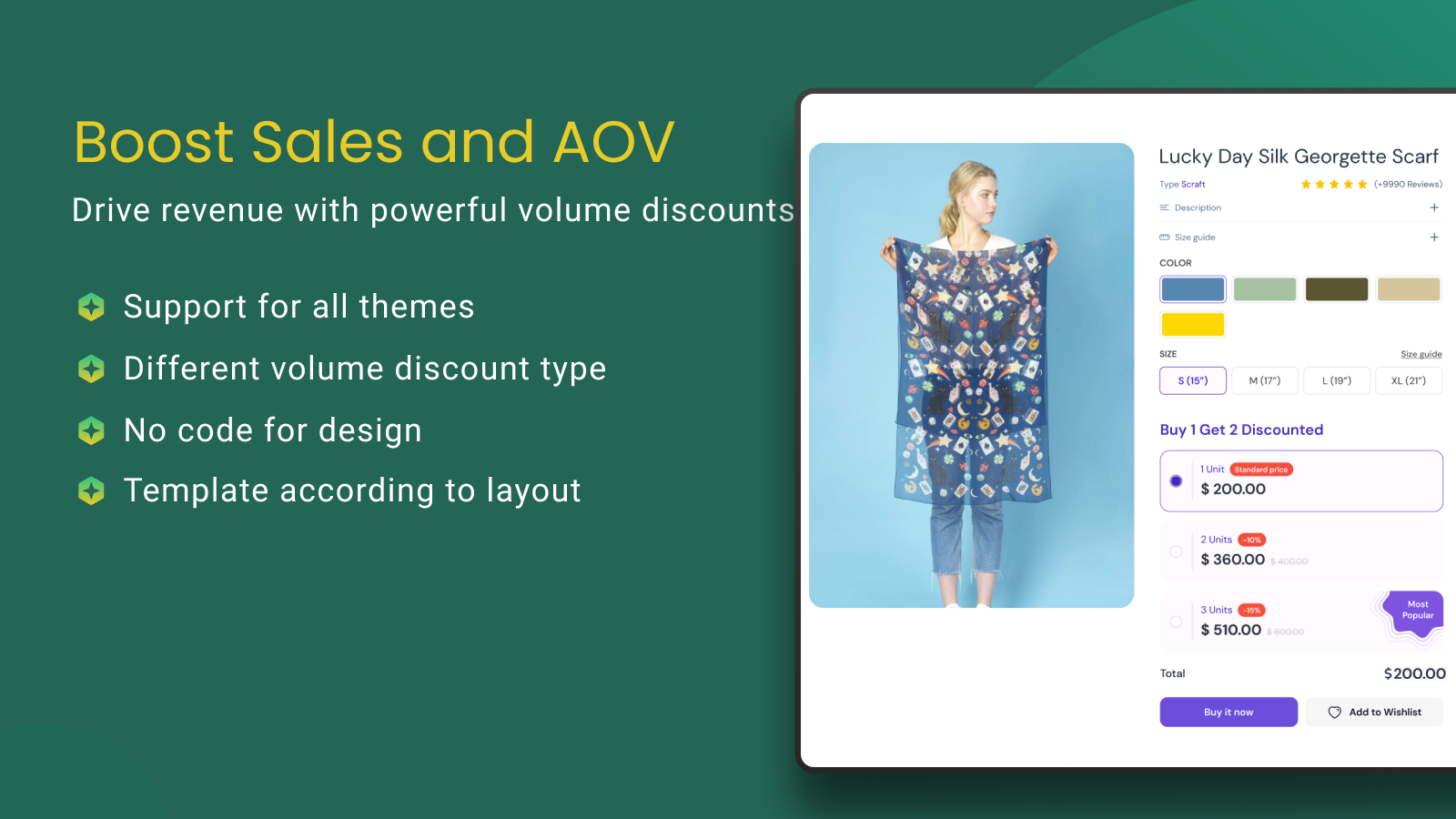
Aris Bundles supports fixed bundles, variant bundles, multipacks, quantity breaks and several discount structures, which makes it useful for testing the offer type that fits your catalog.
What to measure after launch
- Offer conversion rate
- Items per order
- Average order value
- Contribution margin per order
- Attachment rate by product
- Return and cancellation rate
- Repeat purchase behavior
Run one clean test at a time. If you change the offer, placement and product assortment simultaneously, you will not know what caused the result.
Final recommendation
Choose a bundle when products form a solution, a volume discount when more units are naturally useful, and BOGO when the reward itself drives action. To build and compare these mechanics, explore Aris Bundles on the Shopify App Store.
Frequently asked questions
Which offer is best for increasing AOV?
There is no universal winner. The best offer fits natural buying behavior and maintains contribution margin after all variable costs.
Can bundle and volume discounts run together?
They can in some setups, but overlapping eligibility may over-discount an order. Define stacking rules and test them.
Is BOGO always “buy one, get one free”?
No. The reward can be discounted or limited to eligible products. State the condition and reward clearly.